.png)
Lansdale & Other Communities Invest in Housing Near Transit

Updated: Aug 24
Building housing density near train stations makes sense.
For starters, people without cars will specifically seek out housing opportunities close to transit so they can easily commute to schools or jobs. (This was part of my logic when I moved to Ardmore in 2015).
Additionally, many train stations in SEPTA’s network are near small businesses such as restaurants and cafes – making them more attractive to potential renters or home buyers. In Lansdale Borough, however, Pennbrook Station off Church Road is not within close proximity to a coffee or ice cream shop.
And that bothers Dominic Vasturia, one of the leaders of Strong Towns Lansdale. They are advocating for robust and comprehensive transit-oriented development features in Lansdale, specifically around Pennbrook since Borough Council is amending the zoning there to allow for townhomes (in this case built by WB Homes).
Citing the occasional train delay, Vasturia told Council on Wednesday night that TOD (including ice cream shops) would “keep me and my money in town” during those unavoidable delays on the train platform.
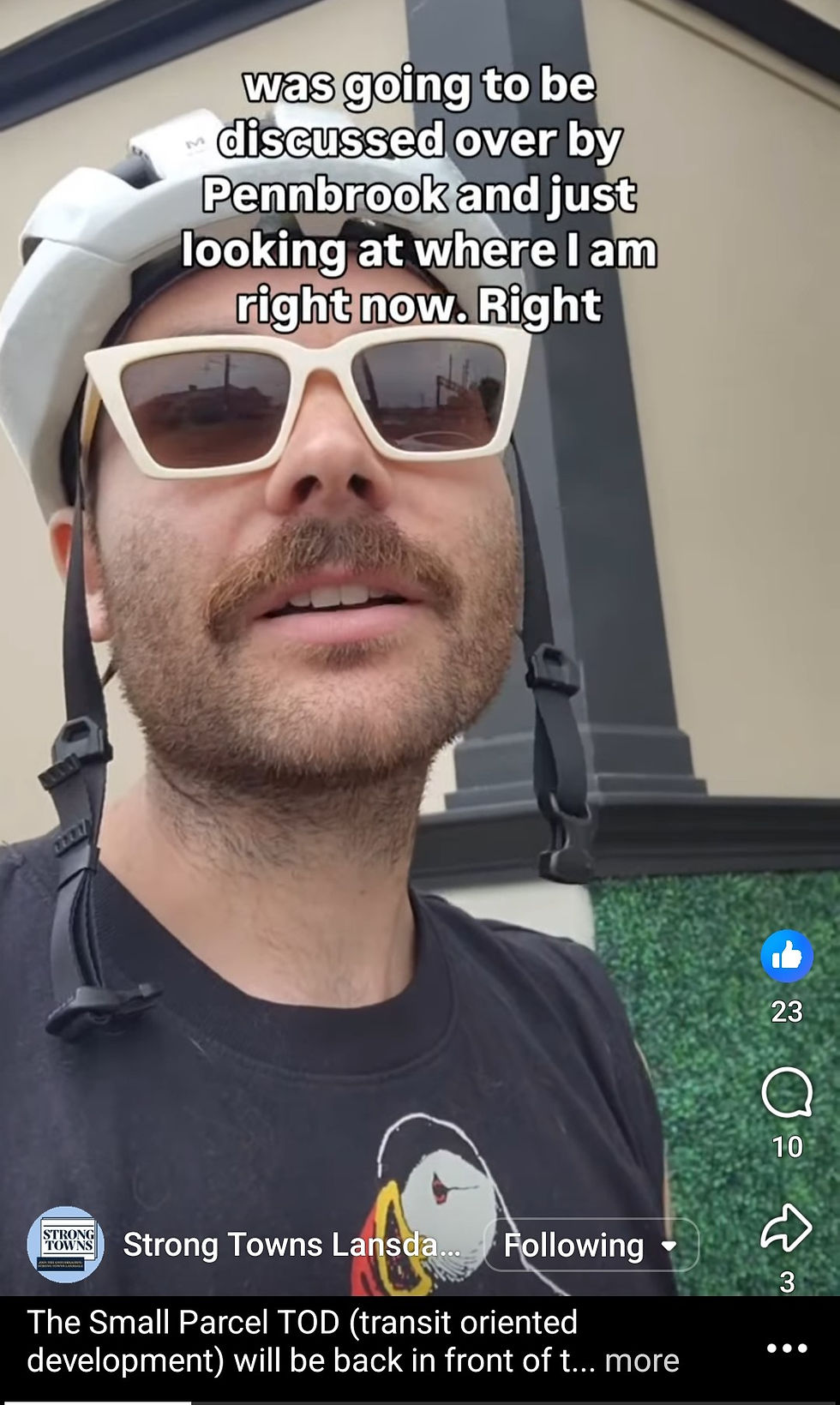
Aiming to make the most of proposed changes, Meghan Kochersperger and Alex Sickler, also members of Strong Towns, outlined several changes they would like to see in Lansdale’s proposed TOD text amendments:
No maximum density - Kochersperger said, "This is probably the most critical thing, as has been brought up by several other people tonight…(the) proposed ordinance would apply to parcels of 5-15 acres within the TOD Overlay District near Pennbrook. As written, this ordinance allows a maximum of 15 dwelling units per acre. In parcels larger than 15 acres, the density maximum is only 12 units per acre."

Attainable housing - Sickler stated: “The required quantities of commercial space or attainable housing are determined based on the number of residential units being built…Under this proposed method for determining requirements, developers will be disincentivized from building smaller and less expensive residential units,” he said.
Also of note is the fact that the ordinance sets affordability to 15 percent less than the market or asking price (not a percentage of income).
Sickler added, “If a developer chooses to build $1 million homes, they only need to build ‘attainable’ houses that are 15 percent less expensive, or $850,000. That’s hardly attainable.”
At a Planning Commission meeting in March, WB Homes President Chris Canavan outlined a proposal with approximately 74 market-rate townhomes (priced over $500,000 apiece), along with six homes priced in the “high $300s.” This would amount for 8 percent of the new development as workforce, attainable housing.
Pedestrian and community amenities – Sickler said, “These amenities (sic) include benches, trash receptacles, bike racks, and wider sidewalks. Under the proposed ordinance, these would not be required for smaller developments, but would be required for larger ones.”
Council Vote
None of these suggested modifications were incorporated into Council's motion Aug. 19.
Councilor Mary Fuller stated that council will evaluate each proposal that applies under the TOD overlay district. She appreciated the “broadness” of the proposed language.
Staff explained to the Council that conditional use hearings would be required for instances when greater density or a specific use (such as an ice cream shop) is proposed under the guidelines. Councilor Garry Herbert asked the solicitor for feedback on what the term “limited retail” means (a term in the ordinance). Patrick Hitchens responded that the borough zoning officer would determine that, based on the application.
Councilor BJ Breish thanked everyone for their input, calling the attainable/workforce component a “monumental step forward.”
“This is a big deal,” Breish said before the unanimous council vote on the TOD Overlay District text amendment.
Land development approvals at a later date will still be required for the WB Homes proposal.
Other Rail Line Developments
Lansdale sits along what was once called the “R5” SEPTA line. There was another R5 train, which confused many travelers, in Chester County (now called Paoli/Thorndale). Thorndale, located in Caln Township, is the site of a hugely successful workforce housing development called The Willows (2131 Lincoln Highway).
You may be wondering if there was “Not in My Backyard” opposition to the 120 apartment complex that utilizes the Low Income Housing Tax Credit (LIHTC).
“In this case, there was none,” Caln Township Manager Don Vymazal said at the Allies for Housing Chester County summit.

Lincoln Highway presents a quintessential transit-oriented development thoroughfare: a busy road with ample shops and some residential. There’s an Aldi, Giant, restaurants, and much more. Chester County has been recognized in recent years for its support of more workforce housing construction.
Elsewhere, several stops down the Paoli/Thorndale line sits Narberth Borough.
Borough officials are exploring density bonuses for fifth floors along Montgomery Avenue, in addition to “missing middle” housing borough-wide. This is another town to keep an eye on, as Narberth considers affordable, pro-housing options.


Comments